From the moment you step on to Campus it’s obvious that trees hold a very special place in the heart of Kenyon College. But this fall the campus lacked some color. At the center of Campus stands a Church, and to the north of the church there is now a hole, a ghost of past shade. A few weeks ago, we lost the Wedding Tree.
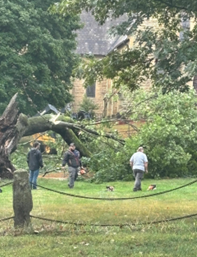
The Norway maple known as the Wedding Tree was a staple for both the campus as a whole and our archaeological site. Norway Maples are native to Europe, brought over by colonizers for landscape and shade. In its native region, Norway maples have been known to live up to 250 years, but their lifespan is much shorter here in North America, sometimes only living 60 years. According to Professor Bruce Hardy, who has been working with the stump, it was likely planted “around the founding of the college, in the 1820s or 30s.” It will be difficult to ever determine the exact date, as the tree suffered rot damage to the center of the stump.

This makes it impossible to fully count its rings. Though the tree was not able to weather this last storm it has truly weathered the test of time living around 200 years old which surpasses its expected lifespan here. In 2002, it was even struck by lightning, and still survived for over 2 decades.
This tree had long been a landmark of the college. It was given the nickname “The Wedding Tree” for the many ceremonies happening in the church that took place beneath its branches.
The cultural and historical significance of this tree is prevalent. It stood as both a symbol of colonization, likely brought from Europe as most Norway maples were. Even after its fall, the stump revealed more hidden treasures.
Professor Petras salvaged around fifty objects from within the tree’s roots and surrounding soil. Among them were pieces of metal, likely nails, along with fragments of window glass similar to those found in nearby excavation plots. There were also brick and charcoal fragments, numerous pottery sherds dating to the early 1800s, and, most intriguingly, several pieces of bone, including an intact hog’s molar.


The trees’ loss leaves a physical and emotional hole on campus but its legacy lives on. From being a symbol of love, to witnessing the college’s growth, to a silent reminder of colonization. It tells a tale of change and resilience.
Similar to the artifacts we now unearth, the Wedding Tree connects us to those who came before. It was likely seen by the first students who attended Kenyon, perhaps even by Bishop Chase himself, gazing from the window of his cabin. Who knows? Maybe students once sat beneath its shade, dreaming of the future, just as we now sit and dream about the past.
References:
“Norway Maple – Borough of Glen Ridge, NJ – Official Website.” Borough of Glen Ridge, NJ – Official Website, 19 Aug. 2025, www.glenridgenj.org/shadetree/norwaymaple/. Accessed 24 Oct. 2025.
“Norway Maple | Minnesota Department of Agriculture.” Www.mda.state.mn.us, www.mda.state.mn.us/norway-maple.


