ANTH 491: Archaeology of the Bishop's Cabin

Category: Uncategorized (Page 1 of 4)

Unearthing the Exotic

Zoe Trexel 27′

The process of excavation is sometimes uneventful. My teammates and I spent a long time in the recesses of our two sub-ops, F and Q, carving up the dirt carefully with our trowels in order to uncover the residuals of the 18th century. Perched on the edge of the square unit, we chat about our lives, our plans for Halloween, and other mundane things. At the same time, we slowly extract that which was once mundane to Philander Chase and other founding members of the college, who once inhabited this structure. The banality of some of these items is not lost on us, as numerous rusted nails, slate fragments, glass pieces appear out of the midden. Upon initial excavations, these pieces were at first exciting. As James Deetz calls them, these small things forgotten, no matter how commonplace underneath the ground, were still decidedly novel for those of us who had not excavated before.

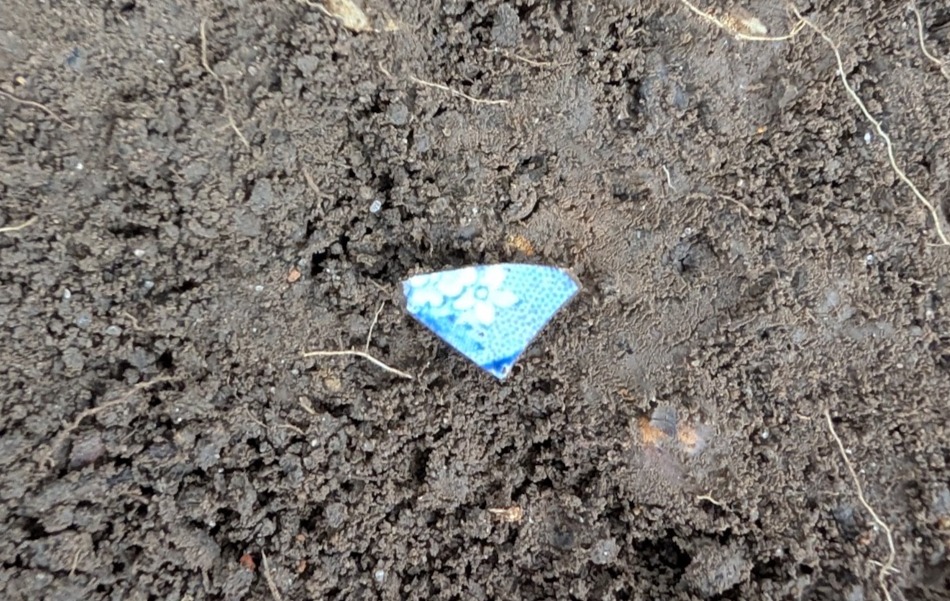
In the past, I’ve done lab analysis before of ceramic sherds and faunal remains, or animal bones. Seeing these pieces emerge from cloth bags, but without being able to visualize their origin in the soil, their appearance felt almost mystical. After trodding home from excavation now every Monday, my dirt-layered jeans and fingernails tell a very different story. Despite this up close and personal experience with the dirt, the landscape, and the retention of objects in the soil, the mystic element still remains to a certain extent. For me, ceramic sherds feel the most rewarding to come across. Usually, a white line appears in the soil, but until you have extracted the sherd, the design is unknown. Most of the designs are plain white glaze or floral in nature.

Even more interesting to me are two unique ceramic sherds that I’ve uncovered throughout the process, each depicting “exotic” scenes. The first find in Unit F consisted of three sherds found in association which were refitted, showing a “savannah” scene with giraffes and palm trees abound. A few weeks later, in Unit Q, I rediscovered another sherd depicting two women carrying parcels under the arms under a background of low-lying shrubbery and huts. Neither of these scenes are of course common to Gambier or England, where these ceramics likely originated – however, they are nonetheless representative of the interests of those who purchased these ceramics. The designs are of an exotic, Othering nature, showing that the owners had some interest in places outside Gambier and even the West despite their isolation.

In the same way that the imagination of the Other in these two sherds seems absurd to me, I am equally abstracted from the objects that I remove in the excavation process. As I interrogate this interest in the exotic, I am also reproducing it in a way, privileging the objects that are the most “unique.” The creators of these ceramics and their purchasers were interested in the distant and far-away, much in the same way that we look upon these pieces now, entirely abstracted from their makers and owners.
Beyond the Dirt

Maya Mikkelsen 27′

A student archaeologist excavating at Kenyon’s Bishop’s Cabin site is often filled with excitement on Mondays before class: “Will we open a new unit today?” “I hope I find a tooth!” or most commonly heard, “I just can’t wait to discuss our readings!” After the first hour of digging, the student’s internal dialogue changes slightly. It sounds a bit like this: “glass…nail…ceramic…glass…bone…button…glass…nail…what is that?”

With our faces in the dirt, we can begin to forget that these artifacts aren’t just objects. We certainly label and identify them in our field journals simply so. These artifacts carry a history of existence along with them, which isn’t forgotten even after nearly 200 years in the ground. When we analyze the artifacts, it’s important to look beyond simply what the object is. Rather, it’s important to look at the lifespan of the object. Where was it made and how? Did it travel and if so, where and how, and even how much would it have cost? Where did we find it, and how was it used there? Specifically, how did the object change throughout its journey, from production to its taphonomy, and what can this tell us about its cultural significance? Chris Gosden & Yvonne Marshall define the answer to these questions as the “use-life” of an artifact. When excavating, it’s extremely important to identify simply what an object is, but the real answers are revealed when we understand how an object is the way it is when we find it. This is called an object biography.

When a student spots a white shine in the site, it’s normally a piece of ceramic, which is a common find. She picks up the sherd and sees that it is a large, curved rim piece. Seeing this, she assumes this is a bowl. Turning it over reveals an intricate gray leafed and flowered pattern on what would be the outside of the vessel. Now the student will surely yell out for the others to look, and wait for the ensuing oohs and ahhs. We make some assumptions in the field, though in the laboratory, we can hope to answer more. Maybe it is possible to identify the maker of this pottery. We can ask, why is this piece here? Was it broken and thrown outside the cabin, or was it still in the cabin when it was destroyed. I often ask myself how the first Kenyon students could break and leave behind so much pottery, which is everywhere for us to find.

The questions become more interesting with the more bizarre finds. You can’t help but wonder about the story of the giant horse tooth you almost missed in the dirt, or the three large-herbivore rib bones stacked right on top of each other, deep in the soil, or even the tiny and intricate buttons that part of you wishes you could put in your pocket and sew onto a piece of your clothing later. These items are compelling, but without a focus on object biography, we wouldn’t be able to answer questions beyond simply identifying what object we have found. Student archaeologists at Kenyon enrolled in Campus Archaeology with the aim of digging, but now it is just as important that we wonder and ask questions about what we find, even if questions begin as simple as “now what could that be?”

Chris Gosden & Yvonne Marshall (1999) The cultural biography of objects, World Archaeology, 31:2, 169-178, DOI: 10.1080/00438243.1999.9980439

Landscape

Charlotte Ostenson 27′

It is week 10 and we are now more than halfway through the semester. This week is our last excavation week before we backfill the units and move our class to a more analytical and discussion based structure. It will be a shame to move class inside because spending all this time outside has made me understand why Philander Chase chose this plot of land for his college. As the weeks go by, we feel more and more at home on Kenyon’s campus, and at the same time, we still feel like Philander Chase’s life at the bishop’s cabin remains a mystery. 

When Chase first saw the hilltop, it was covered in trees and could not possibly seem like a proper college, but he saw something in the land. In an archival record called Bishop Chase’s Reminicences, Chase describes, “on the south end or promontory of this hill… grew some tall oak trees” and construction of the college was started “after the brush was with great difficulty cleared away”. The creation of Kenyon changed the landscape from unbridled forest to manicured campus. But this beautiful landscape is more than just a scenic destination. Just as Chase shaped the land, the land has shaped campus life since its founding in 1824. Our excavation efforts at the Bishop’s Cabin site help reveal the relationship between the inhabitants of Gambier and the natural land. Philander Chase’s first cabin was closer to where the Old Kenyon dormitory is today, but eventually, he moved to the spot that we are excavating now  because there was a well in that area and it would have provided better access to water. Kenyon’s campus was likely first built on today’s south campus because it is much closer to the Kokosing river, but soon enough irrigation technologies allowed for the north campus to be built. 

Through our excavation, I have been hoping to find some things that point towards a way of life in relation to the land. The closest thing we have found to that is a few animal bones that could potentially suggest a background in raising livestock, which would not have been unusual for the time period. Other than that, the nails, glass, and ceramic pieces that we continue to find tell us things about domestic life, but not necessarily the land. To quote our very own Professor Novotny, she said “We’re hoping that this will tell us a lot about what daily life was like, what student life was like, what people were eating”. While we have not found anything quite groundbreaking, it is still a valuable experience to learn about how everyday items of the past can tell us so much about Kenyon’s rich history.

The Stories Objects Tell

Eleanor Retish’ 28

Every Monday, I wake up looking forward to two things: one, Peirce grilled cheese and tomato soup, and two, digging around in the dirt for three hours and finding fun surprises from artifacts that haven’t seen the light of day in two hundred years. That being said, it is easy to get wrapped up in the fun of the excavation and forget about the significance of the objects. Luckily, this week KAP is focusing on object biographies, which offers a great way to think about objects in a more anthropological and—I hate to say it but—less whimsical way.

Object biographies are an exercise of writing the ethnographic and historical story of an object, offering “a useful mechanism to explore and understand” the different meanings that the object has carried across time and exchanges (Fowler et al 2016: 212). The idea of object biographies emerged in the 1980s, pioneered by works from anthropologists Arjun Appadurai and Igor Kopytoff, and aligning with the individual identity-focused ideas of post-processualism. By considering how objects affect human culture, rather than how objects are affected by humans, we flip the analysis from a passive to an active one and attempt to “understand the way objects become invested with meaning through the social interactions they are caught up in” (Gosden and Marshall 170).

To give an example of what can be gained from an object biography, we can look at our Bishop’s Cabin site. This past week in Suboperation Q, my classmates and I found two plain white cylindrical beads. Much more historical research is needed to create a complete object biography of them, but just from the current information we have about them, many questions to answer arise. What did these beads originally decorate? A necklace? A garment? Something else? Who owned the beads in the cabin, and did they have any previous owners? Where did the beads come from before they were brought to the cabin? How did the beads end up being buried? Although we won’t be able to answer all of these questions, there are certain things we might be able to find that would contribute to an object biography about these beads.

In Subop Q we are investigating how the rocks we found in it are related to the foundation, or if they are at all. If we determine this, then we will be able to understand geographically where in the cabin these beads fell and were buried, which might answer some questions about ownership. Additionally, doing more historical research on beads and beadwork in Ohio during the 1820s might allow us to situate the beads in their historical context, and perhaps understand their own personal history better.

As we transition in the next few weeks from excavation to analysis in the lab, we will be able to learn more about the objects that we have found and interrogate more into each of their biographies. I look forward to sharing the stories we find with you all!

Works cited:

Fowler, Madelin, Roberts, Amy, and Rigney, Lester-Irabinna. “The ‘very stillness of thing’: object biographies of sailcloth and fishing net from the Point Pearce Aboriginal Mission (Burgiyana) colonial archive, South Australia.” World Archaeology, vol. 48, no. 2, pp. 210–225, 2016, https://doi.org/10.1080/00438243.2016.1195770. 

Gosden, Chris and Marshall, Yvonne. “The cultural biography of objects.” World Archaeology, vol. 31, no. 2, pp. 169–178, 1999, https://doi.org/10.1080/00438243.1999.9980439.

Community Archaeology

Wesley Brock 28′

On October 17, the Department of Anthropology hosted its latest of many community archaeology events. Since the beginning of the Kenyon Archaeological Project in 2023, as is true of increasingly many excavations in the past forty years (Stubbs et al.), community engagement has been a central focus. As both the Anthropology Department office intern and a student in the Campus Archaeology course, I faced an interesting question approaching this semester’s community engagement event: what appeals to people about archaeology?

1. You get to dig in the dirt

Archaeology is a uniquely sensory, immersive practice. On Mondays when my Campus Archaeology class is out at the site all afternoon, I hear constant references to the physicality of our work: “My back hurts,” “My feet are wet,” “The sun is killing me.” The importance of the body to archaeology is one of its most appealing aspects for me. In addition to academic strategies, you go into archaeology with physical strategies — kids at the community archaeology day were reminded to be physically gentle with the ground. Archaeology is tactile — you get to feel the things you’re studying and the earth those things are held within.

2. You get your hands on history

“Get your hands on Kenyon history” was my pseudo-motto for this weekend’s community archaeology day. Just as you get to feel the ground, you feel the processes of time. The past might be out of sight, buried under a lawn you might pass every day, but it’s really only a few inches (or centimeters!) beneath the surface.

The village of Gambier and Kenyon College are remarkable for having a united and well-documented origin story. Stakeholders in Kenyon history are not limited to Kenyon students and faculty; everyone living in Gambier has a deep investment in this origin story. While not everyone knows exactly what is going on with that orange fence outside the church, the fence signals that there is work taking place, and community events signal that the work is a shared work. I have found while working on this project that it takes quite a lot to make people aware of it: students express disbelief that there is anything worth looking at under Kenyon’s well-maintained turf. 

Gambier and Kenyon also have the notable aspect of being small. In addition to investment in the past, we have an investment in each other that the physical work of excavation brings to the surface like any artifact.

In contrast with the idea that students are a central stakeholder group in campus archaeology projects (Kroot & Panich), not many students uninvolved with the Campus Archaeology course attended the event. However, there was steady attendance from other community members. Kids got quite invested and enjoyed using picks to look for ceramic pieces, rusty spoons, skinny nails, and interesting rocks. I asked why they thought there were so many nails. “Because there was a house here,” said 7-year-old Ava. A decisive start to her academic career.

Kroot, Matthew, and Lee M. Panich. 2020. “Students Are Stakeholders in On-Campus Archaeology.” Advances in Archaeological Practice: A Journal of the Society of American Archaeology 8 (2): 134–50.

Stubbs, John D., Patricia Capone, Christina J. Hodge, and Diana D. Loren. 2010. “Campus Archaeology/Public Archaeology at Harvard University, Cambridge, Massachusetts.” In Beneath the Ivory Tower: The Archaeology of Academia, edited by Russell K. Skowronek and Kenneth E. Lewis, 99-120. Gainesville: University Press of Florida.

The Kenyon Community at Community Archaeology Day

Hannah Dunn-Helton, ‘27

On the morning of Saturday, October 17th, Kenyon students, their families, community members, and elementary schoolers braved the cold weather to pick up their trowels and search for a piece of Kenyon’s history as part of Community Archaeology Day at the Bishop’s Cabin site. I spent the day with a group of elementary school students in a shallow unit known as sub op L, all of whom were quite enthusiastic about getting dirty, searching for treasure, and
discovering history. We worked diligently to excavate as much as we could. Several of the boys took the opportunity to mine for gold like they would in the video game Minecraft, turning ordinary rocks into valuable finds. One young girl explained to me her theory that zombies lived underneath the ground at the college and we were unearthing a portion of their city.

As I excavated with the kids, the rest of the site filled up with people. There were, of course, the kids’ parents, some of whom were Kenyon professors and others of whom lived in Gambier and Mount Vernon. Community Archaeology Day aligned with Kenyon’s Family Weekend, so visiting families poured in to find out what was behind the fence. Curious students also stopped by to discover what they passed on their way to class every day. Throughout the
site, campus archaeology students guided visiting community members through basic archaeological procedures and discussed the history of the site and the artifacts discovered there. Visitors then began excavating themselves. They were excited to see pieces of history emerge from the ground in front of them, dusting the artifacts off and handing them around so everyone could see the treasure that had been discovered.

Seeing so many people participate in the excavation helped me to appreciate the diversity of Kenyon’s community. It makes sense that the faculty, students, and staff at Kenyon are considered part of the community. Yet the village of Gambier, Mount Vernon, parents and families, and alumni are all part of Kenyon’s community as well. Community is not always an easy concept for archaeologists to define. There are some situations, such as when working
with Indigenous groups, when identifying specific communities becomes very important. On a project like this, however, community is much more expansive. Kenyon has meant a great deal of things to a great many people over the years. Archaeologists learn from the perspectives of the local community on the site. The community learns their place in and relationship to the history the excavation reveals. The Kenyon Archaeological Project is working to include as
many members of the community as possible in our project through as many methods as possible. As we dug for the buried treasure of the Kenyon community’s past, a fifth grader told me that he couldn’t believe there was so much history in his hometown. He was excited to discover more. Such little moments of connection between the community and the history that makes the community is truly what archaeology is all about.

Historical Archaeology

by Clemmie Anzalone 27′

Historical Archaeology

In order to get the most comprehensive look possible when approaching things archaeologically, we need to consider a variety of sources. Just as it would be unwise and unproductive to go into a dig not knowing how to do the technical work of archaeology, approaching a dig with as much background information and context as possible is incredibly important. Historical archaeology makes up both of these categories, as it focuses on the material remains of history. This can mean anything from physical objects like textiles or ceramics, as well as written records of the past. This is a practice that began very recently, most formally in the 1960s. (Orser, Charles E. “Historical Archaeology | Oxford Bibliographies in Anthropology | Oxford Academic.” Oxford Academic, March 29, 2019. https://academic.oup.com/reference/62334/reference-article-abstract/561705044?redirectedFrom=fulltext.) As archaeology and anthropology have become more interdisciplinary in recent years, historical archaeology has become much more commonplace. 

For our first class of the semester, before we even got onto the dig site, we started by looking at some materials having to do with the history of Kenyon overall. We looked through various class and student directories, as well as some letters sent to and from the college in the 19th century. These firsthand documents helped to humanize past students and made their lives much more tangible to me. While finding objects alone is exciting and helps us to understand the everyday life of past people, having the right context surrounding this is what makes the information important. Recently, we have been finding lots of bones in our dig. As I have learned which bones belong to pigs and which belong to cows, I am able to imagine the kinds of meals the people living here would have been eating. While I’m sure I could have figured out where these bones came from eventually if I dug them up with no context, having the background information that the college was largely self-sufficient at its founding and animals like pigs and cows lived on campus, information I got from our day of research in the archives before excavating, I am able to paint a much richer picture of the past. 

We also found a piece of a pipe in my sub-op in the dig. This has been one of the more interesting finds for me because it tells us something about the habits of the people living here. We can say with certainty that any person who lived at Kenyon in the 19th century ate something, but a pipe tells us more about what they spent their time doing outside of what is needed to survive. It fills in the context we do not get from official documents.

Orser, Charles E. “Historical Archaeology | Oxford Bibliographies in Anthropology | Oxford Academic.” Oxford Academic, March 29, 2019. https://academic.oup.com/reference/62334/reference-article-abstract/561705044?redirectedFrom=fulltext.

Household Objects at Bishop’s Cabin by Sari Wachtelhausen 27′

This past week, our continued dig was accompanied by blustery weather and wet conditions – no complaints here; it kept us cool! We were quickly underway with continuing to open up new suboperations and deepen older ones, despite some mud. The day was marked by a number of small finds, all one after the other: nails with square heads, blue and white pieces of porcelain, and even what seems to be a metal handle. This variety of household remnants was found about 7 inches below the surface and deeper, among a layer of dirt that heralded the discovery of new pieces every few minutes. These hints of everyday life provided moments for reflection and insight about what objects were used by those living at Bishop’s Cabin.

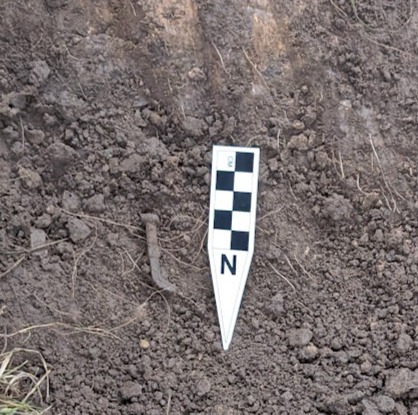
A nail in Suboperation P, photo by Sari Wachtelhausen

Every small find added another layer to our understanding of, and relationship to, the early days of Kenyon College. Professor Novotny noted that, in some cases, porcelain was ordered from England and sometimes personalized for the purchaser, perhaps mentioning Gambier in the images and etchings depicted on the item. It is fascinating to consider the lifecycle of a tiny shard of porcelain or ceramic found in the site, from a manufacturer overseas, to arrival in Gambier, perhaps many years of use in a kitchen or for decoration, then broken pieces forgotten in the floorboards, to be dug up years later by curious students. The same goes for the nails, especially the ones with square heads, suggesting that they were made nearby within Knox County. While not strictly “household items,” nails helped hold up the physical structure of the living space, and finding them scattered and intact is proof of a previously stable home where everyday activities took place.

A small shard of porcelain in Suboperation P, photo by Sari Wachtelhausen

Household archaeology provides a framework for the analysis of everyday objects for the benefit of understanding the social and economic contexts of a site. Studying the household and the objects utilized within it provides a meaningful way to connect individual people to greater processes, focusing on specificity rather than a grand narrative (Pluckhan 2010, p. 332). While the foundations of the cabin and the blue rim of a plate both offer insight into daily life in 1800s Gambier, focusing on the plate shard specifically familiarizes us with the individuals whose space we are investigating, allowing us to find a relation with them. From this plate, as Professor Novotny highlighted, we can draw conclusions about broader economic processes and interactions both within and outside the household. If the porcelain is found to come from overseas, then who ordered it? What kind of utensil was the warped metal handle a part of? These and many other questions come to mind when such artifacts are uncovered, and while some may never be truly answered, the act of considering them in the first place weaves together the many processes that go into daily life in the early days of Gambier. The foundations of Bishop’s Cabin are sure to hold many more material hints of routines and practices, soon to be found in the coming weeks. 

Pluckhahn, T. J. (2010). Household Archaeology in the Southeastern United States: History, Trends, and Challenges. Journal of Archaeological Research, 18(4), 331–385. http://www.jstor.org/stable/23018401 

Excavation Day 1: Where are the Units?

Later today, our campus archaeology team will be excavating for the second week in a row. Knock on wood, the weather is nice, or at least out of our way during excavations (it’s 96% humidity today, yikes!).  Let me update you on what we did last week, on our first day of excavation. 

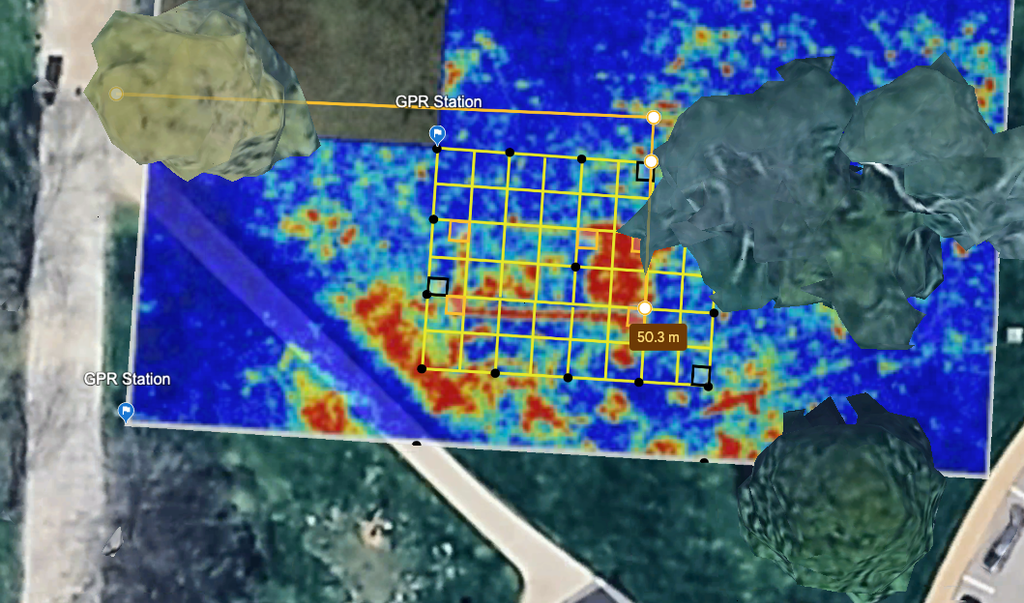
Our first challenge was to locate last year’s units. We mapped and georeferenced all excavation units using a high-precision Global Positioning System (GPS). This survey tool lets anyone locate a feature (or really a point) in space using Latitude and longitude coordinates from satellites around the Earth. Most phones, cars, and other devices have navigation systems that use GPS; however, the devil is in the details, as they say. Commercially available GPS has an average error of 3 to 5 meters (9 to 16.6 feet), which works well for finding your favorite coffee shop or traveling to Columbus, but not for locating a precise point in space. GPS with less than 1cm of horizontal error can cost tens of thousands of dollars. So how do we locate the units from previous years without spending enough money to buy a used Subaru Outback?   

The good news is that we have a georeferenced grid, where we have the exact location of our units. Using basic mapping software like, say, Google Earth, we can see the grid over a Landsat image of the ground. Then what we did was measure from a known feature that we know did not move, in this case, the water cistern to the east and the gates of hell to the west. Additionally, the ground is slightly depressed where we have previously excavated. This is because the backfill at the end of the season settles and sinks slightly below the surrounding ground level. 

Google Earth image showing the location of the excavation grid, some of the units, and a triangulation between gates of hell, units and grid.
Google Earth image showing the location of the excavation grid, some of the units, and a triangulation between gates of hell, units, and grid.

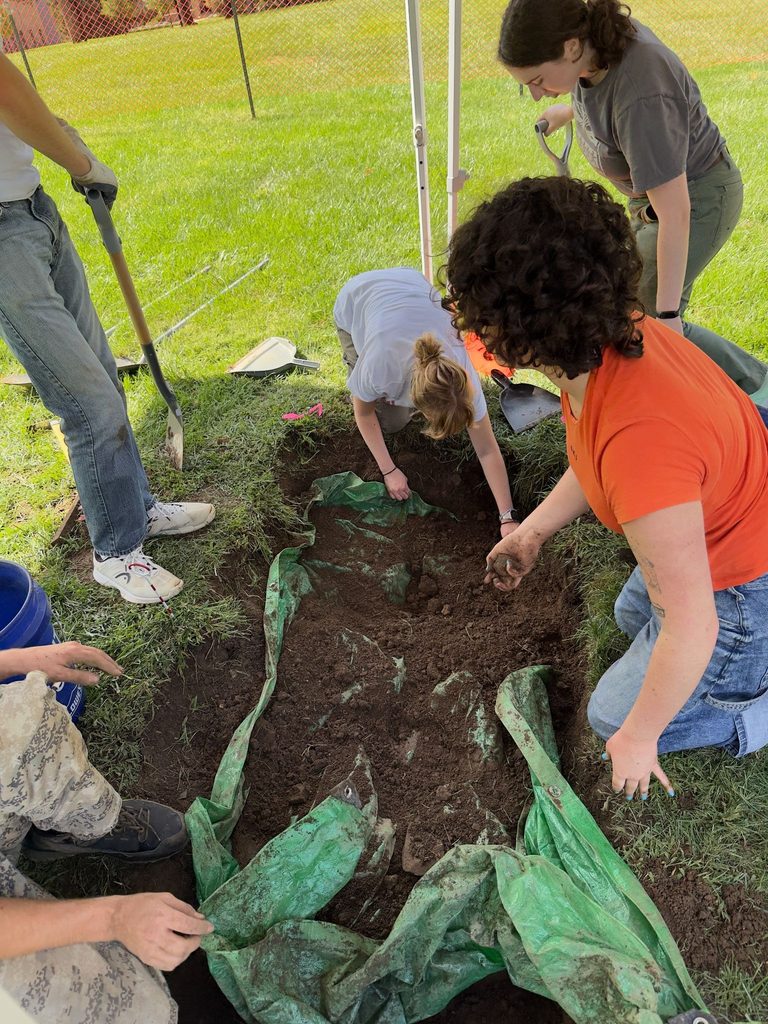
The trial by fire, however, is excavating and opening up an old unit to remove the backfill from previous years. In this case, we were trying to uncover Unit E where the south-eastern corner of the refectory was located. The soil was sterile, meaning that it had no artifacts (which is a good indication that it’s backfill). The soil was also very consistent brown clay throughout and relatively soft (soil that has been compacted for multiple years gets compacted and can be hard to excavate). Finally, we located some nails, flag tape, and a tarp from previous years—our calculations had worked! Now we can open new units, and the excavations for new data are on their way!  

Green tarp from 2025’s archaeological season, and backfill covering the southeast corner of the refactory.

Diving Back into the Past: Beginning the 2026 Bishop’s Cabin Excavation! 

By Eva Panza’ 29 

As another academic year begins at Kenyon College, so does another dig season at the Bishop’s Cabin site. With fourteen new budding archaeologists ready to start digging this coming week, it’s looking like the season is off to a good start. But what will be the focus for the site this year? To better understand what will be guiding this year’s dig, we have to take a look at last year’s highlights.

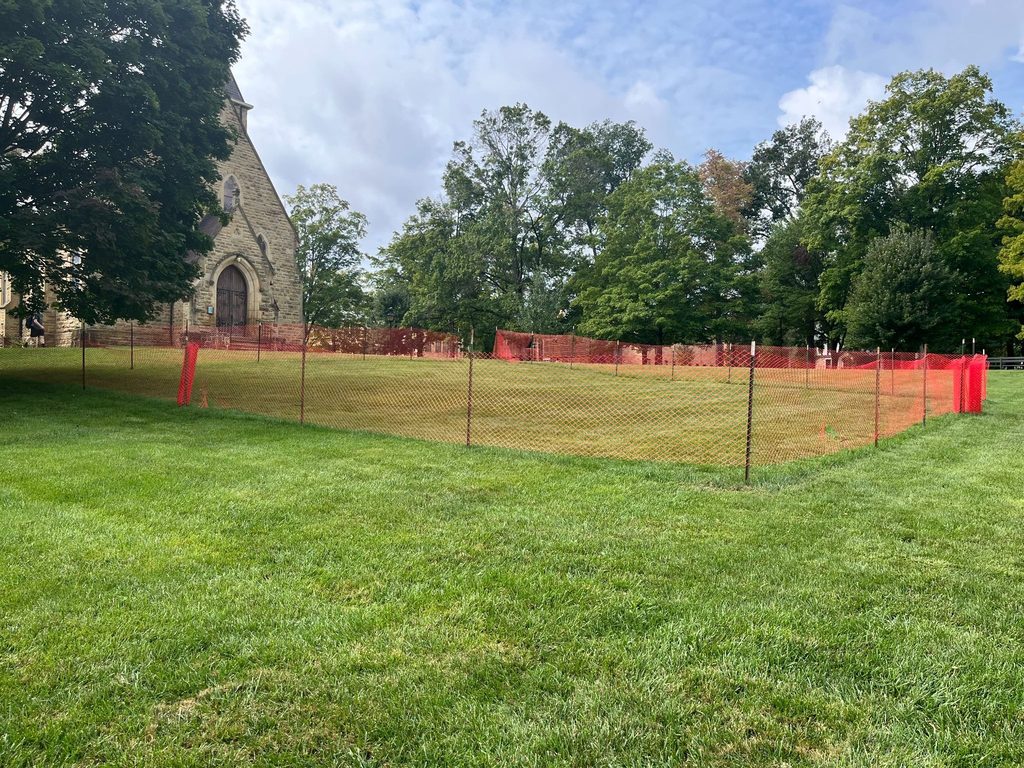
The Bishop’s Cabin Site, a few days prior to the start of the 2026 excavation, in front of the Church of the Holy Spirit.

In fall 2025, we excavated parts of the stone foundation of the original Kenyon dining hall (i.e., refectory ). The team focused on locating the corners of the structure while analyzing the larger garbage dump just outside the dining hall walls. The garbage dump revealed a host of artifacts including animal teeth and bone, ceramic sherds, and even delicate pieces of smoking pipes. These artifacts give us a snapshot of what life was like during the early days of the college, helping us to better understand students’ and faculty’s day-to-day lives in the early 19th century.

Also, during last year’s excavation, the Norway maple known as the Wedding Tree fell during a strong wind storm. Roughly dating from the founding of the college, the Wedding Tree had been a staple of Kenyon’s campus for decades, becoming a common wedding photography spot. Many members of the Kenyon community felt the loss of the old Norway maple deeply. However, the Wedding Tree’s untimely end gave the excavation a unique opportunity to “excavate” its roots. From the roots of the Wedding Tree, we recovered glass, ceramic, brick, bone, and charcoal, all dating roughly to the early 19th century. In a way, the Wedding Tree became another feature to analyze.

With what we found last year, what does this mean for the site today? In short, it means a lot more digging!

This year, we hope to uncover more of the dining hall’s stone foundation. This includes uncovering one of the foundation edges left covered last year and revealing more of the structure’s walls—something I can’t wait to see! The excavation will also focus on more areas outside of the dining hall structure. After the amazing finds from the garbage dump last year, the hope is to find more of these concentrated groups of artifacts around the dining hall. 

As for the Wedding Tree, what remains of the stump is located in Palme House. The hope is to find a way to smooth and preserve the stump to save this important piece of Kenyon’s early history. At the moment, Professor Tomás Gallareta Cervera is working with members of Kenyon’s visual arts department to find a way to save the Wedding Tree stump. 

Even with everything that has already been done, we have only scratched the surface of the Bishop’s Cabin site. It seems that it will be another wonderful year of excavation, and we can’t wait to show you what we find!   

« Older posts
css.php