By Eva Panza’ 29
As another academic year begins at Kenyon College, so does another dig season at the Bishop’s Cabin site. With fourteen new budding archaeologists ready to start digging this coming week, it’s looking like the season is off to a good start. But what will be the focus for the site this year? To better understand what will be guiding this year’s dig, we have to take a look at last year’s highlights.
In fall 2025, we excavated parts of the stone foundation of the original Kenyon dining hall (i.e., refectory ). The team focused on locating the corners of the structure while analyzing the larger garbage dump just outside the dining hall walls. The garbage dump revealed a host of artifacts including animal teeth and bone, ceramic sherds, and even delicate pieces of smoking pipes. These artifacts give us a snapshot of what life was like during the early days of the college, helping us to better understand students’ and faculty’s day-to-day lives in the early 19th century.
Also, during last year’s excavation, the Norway maple known as the Wedding Tree fell during a strong wind storm. Roughly dating from the founding of the college, the Wedding Tree had been a staple of Kenyon’s campus for decades, becoming a common wedding photography spot. Many members of the Kenyon community felt the loss of the old Norway maple deeply. However, the Wedding Tree’s untimely end gave the excavation a unique opportunity to “excavate” its roots. From the roots of the Wedding Tree, we recovered glass, ceramic, brick, bone, and charcoal, all dating roughly to the early 19th century. In a way, the Wedding Tree became another feature to analyze.
With what we found last year, what does this mean for the site today? In short, it means a lot more digging!
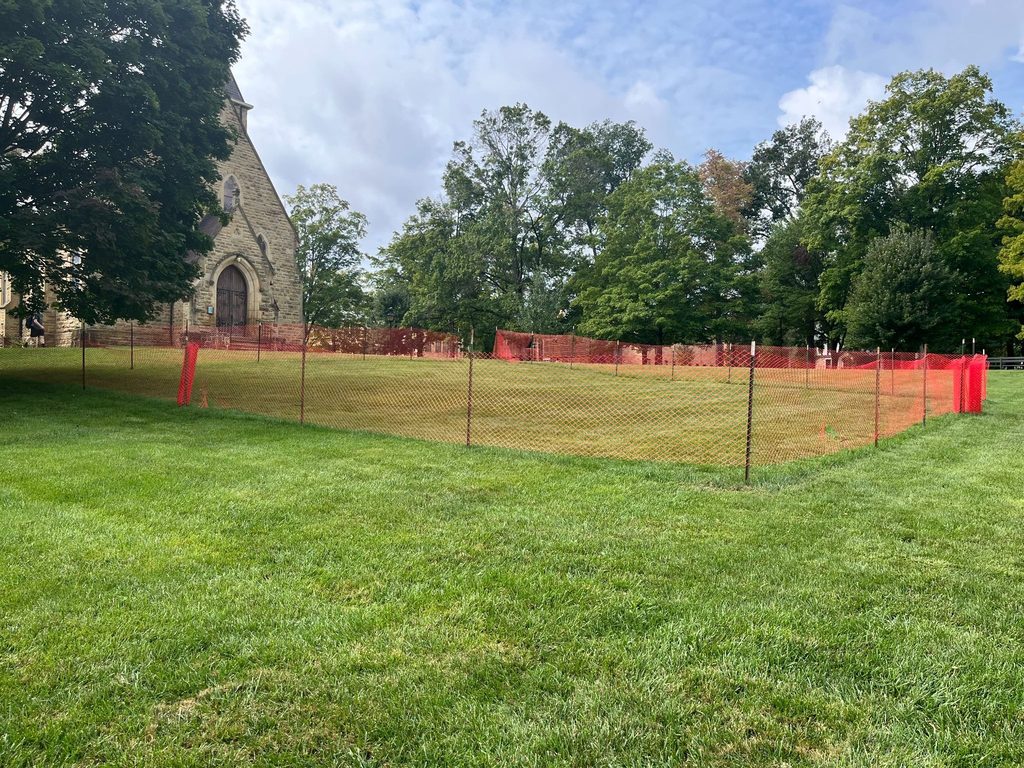
This year, we hope to uncover more of the dining hall’s stone foundation. This includes uncovering one of the foundation edges left covered last year and revealing more of the structure’s walls—something I can’t wait to see! The excavation will also focus on more areas outside of the dining hall structure. After the amazing finds from the garbage dump last year, the hope is to find more of these concentrated groups of artifacts around the dining hall.
As for the Wedding Tree, what remains of the stump is located in Palme House. The hope is to find a way to smooth and preserve the stump to save this important piece of Kenyon’s early history. At the moment, Professor Tomás Gallareta Cervera is working with members of Kenyon’s visual arts department to find a way to save the Wedding Tree stump.
Even with everything that has already been done, we have only scratched the surface of the Bishop’s Cabin site. It seems that it will be another wonderful year of excavation, and we can’t wait to show you what we find!

Leave a Reply