ANTH 491: Archaeology of the Bishop's Cabin

Month: September 2026

Household Objects at Bishop’s Cabin by Sari Wachtelhausen 27′

This past week, our continued dig was accompanied by blustery weather and wet conditions – no complaints here; it kept us cool! We were quickly underway with continuing to open up new suboperations and deepen older ones, despite some mud. The day was marked by a number of small finds, all one after the other: nails with square heads, blue and white pieces of porcelain, and even what seems to be a metal handle. This variety of household remnants was found about 7 inches below the surface and deeper, among a layer of dirt that heralded the discovery of new pieces every few minutes. These hints of everyday life provided moments for reflection and insight about what objects were used by those living at Bishop’s Cabin.
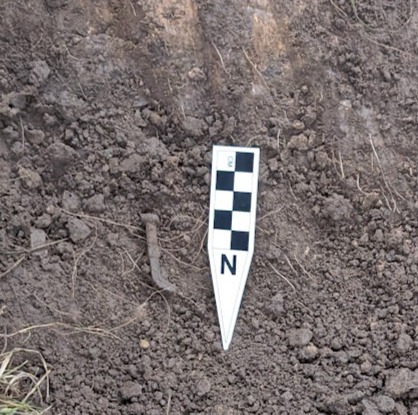
A nail in Suboperation P, photo by Sari Wachtelhausen

Every small find added another layer to our understanding of, and relationship to, the early days of Kenyon College. Professor Novotny noted that, in some cases, porcelain was ordered from England and sometimes personalized for the purchaser, perhaps mentioning Gambier in the images and etchings depicted on the item. It is fascinating to consider the lifecycle of a tiny shard of porcelain or ceramic found in the site, from a manufacturer overseas, to arrival in Gambier, perhaps many years of use in a kitchen or for decoration, then broken pieces forgotten in the floorboards, to be dug up years later by curious students. The same goes for the nails, especially the ones with square heads, suggesting that they were made nearby within Knox County. While not strictly “household items,” nails helped hold up the physical structure of the living space, and finding them scattered and intact is proof of a previously stable home where everyday activities took place.
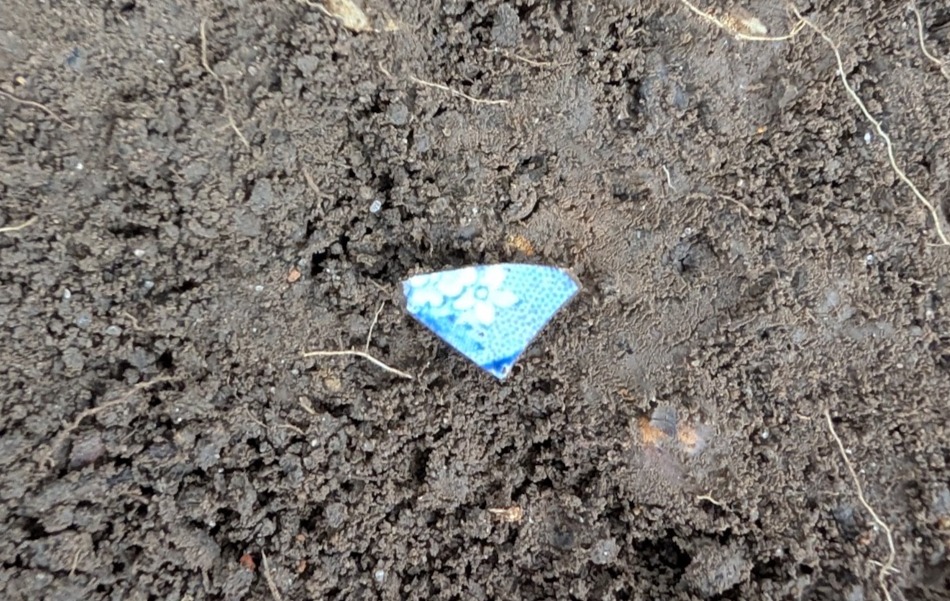
A small shard of porcelain in Suboperation P, photo by Sari Wachtelhausen

Household archaeology provides a framework for the analysis of everyday objects for the benefit of understanding the social and economic contexts of a site. Studying the household and the objects utilized within it provides a meaningful way to connect individual people to greater processes, focusing on specificity rather than a grand narrative (Pluckhan 2010, p. 332). While the foundations of the cabin and the blue rim of a plate both offer insight into daily life in 1800s Gambier, focusing on the plate shard specifically familiarizes us with the individuals whose space we are investigating, allowing us to find a relation with them. From this plate, as Professor Novotny highlighted, we can draw conclusions about broader economic processes and interactions both within and outside the household. If the porcelain is found to come from overseas, then who ordered it? What kind of utensil was the warped metal handle a part of? These and many other questions come to mind when such artifacts are uncovered, and while some may never be truly answered, the act of considering them in the first place weaves together the many processes that go into daily life in the early days of Gambier. The foundations of Bishop’s Cabin are sure to hold many more material hints of routines and practices, soon to be found in the coming weeks. 

Pluckhahn, T. J. (2010). Household Archaeology in the Southeastern United States: History, Trends, and Challenges. Journal of Archaeological Research, 18(4), 331–385. http://www.jstor.org/stable/23018401 
Excavation Day 1: Where are the Units?

Later today, our campus archaeology team will be excavating for the second week in a row. Knock on wood, the weather is nice, or at least out of our way during excavations (it’s 96% humidity today, yikes!).  Let me update you on what we did last week, on our first day of excavation. 

Our first challenge was to locate last year’s units. We mapped and georeferenced all excavation units using a high-precision Global Positioning System (GPS). This survey tool lets anyone locate a feature (or really a point) in space using Latitude and longitude coordinates from satellites around the Earth. Most phones, cars, and other devices have navigation systems that use GPS; however, the devil is in the details, as they say. Commercially available GPS has an average error of 3 to 5 meters (9 to 16.6 feet), which works well for finding your favorite coffee shop or traveling to Columbus, but not for locating a precise point in space. GPS with less than 1cm of horizontal error can cost tens of thousands of dollars. So how do we locate the units from previous years without spending enough money to buy a used Subaru Outback?   

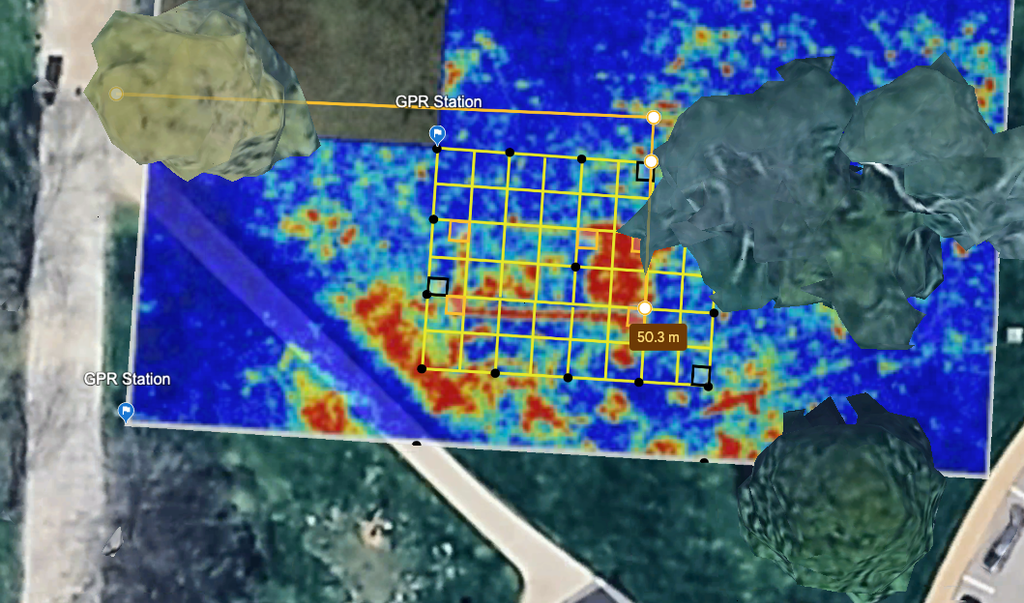
The good news is that we have a georeferenced grid, where we have the exact location of our units. Using basic mapping software like, say, Google Earth, we can see the grid over a Landsat image of the ground. Then what we did was measure from a known feature that we know did not move, in this case, the water cistern to the east and the gates of hell to the west. Additionally, the ground is slightly depressed where we have previously excavated. This is because the backfill at the end of the season settles and sinks slightly below the surrounding ground level. 

Google Earth image showing the location of the excavation grid, some of the units, and a triangulation between gates of hell, units and grid.
Google Earth image showing the location of the excavation grid, some of the units, and a triangulation between gates of hell, units, and grid.

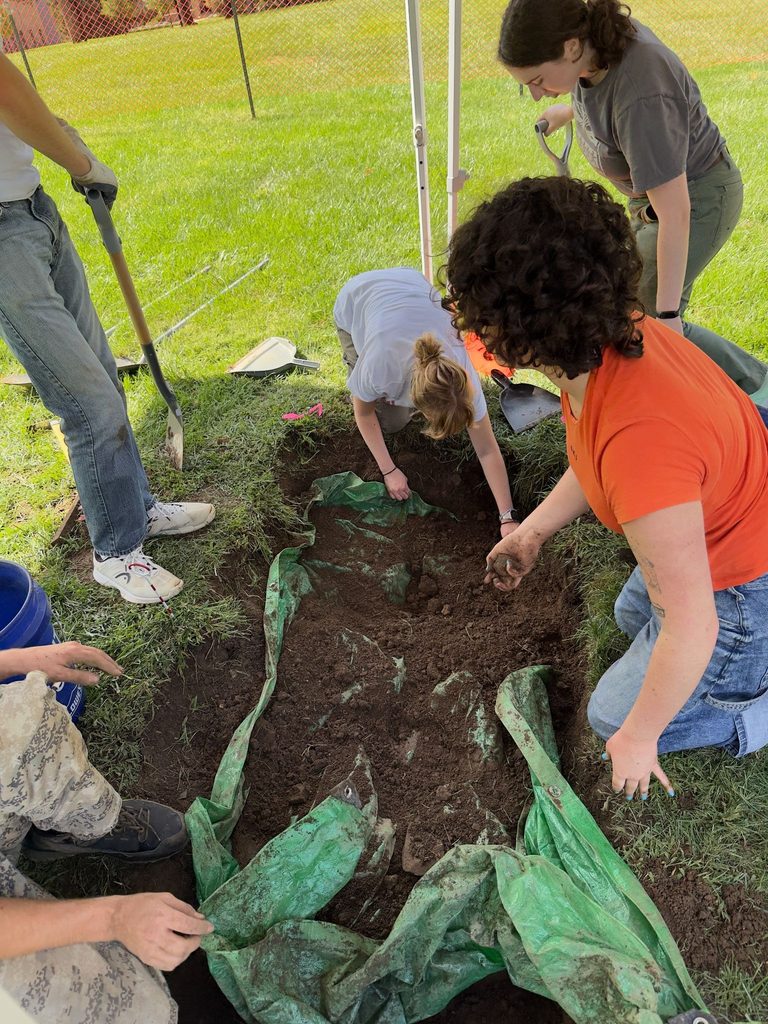
The trial by fire, however, is excavating and opening up an old unit to remove the backfill from previous years. In this case, we were trying to uncover Unit E where the south-eastern corner of the refectory was located. The soil was sterile, meaning that it had no artifacts (which is a good indication that it’s backfill). The soil was also very consistent brown clay throughout and relatively soft (soil that has been compacted for multiple years gets compacted and can be hard to excavate). Finally, we located some nails, flag tape, and a tarp from previous years—our calculations had worked! Now we can open new units, and the excavations for new data are on their way!  

Green tarp from 2025’s archaeological season, and backfill covering the southeast corner of the refactory.

Diving Back into the Past: Beginning the 2026 Bishop’s Cabin Excavation! 

By Eva Panza’ 29 

As another academic year begins at Kenyon College, so does another dig season at the Bishop’s Cabin site. With fourteen new budding archaeologists ready to start digging this coming week, it’s looking like the season is off to a good start. But what will be the focus for the site this year? To better understand what will be guiding this year’s dig, we have to take a look at last year’s highlights.

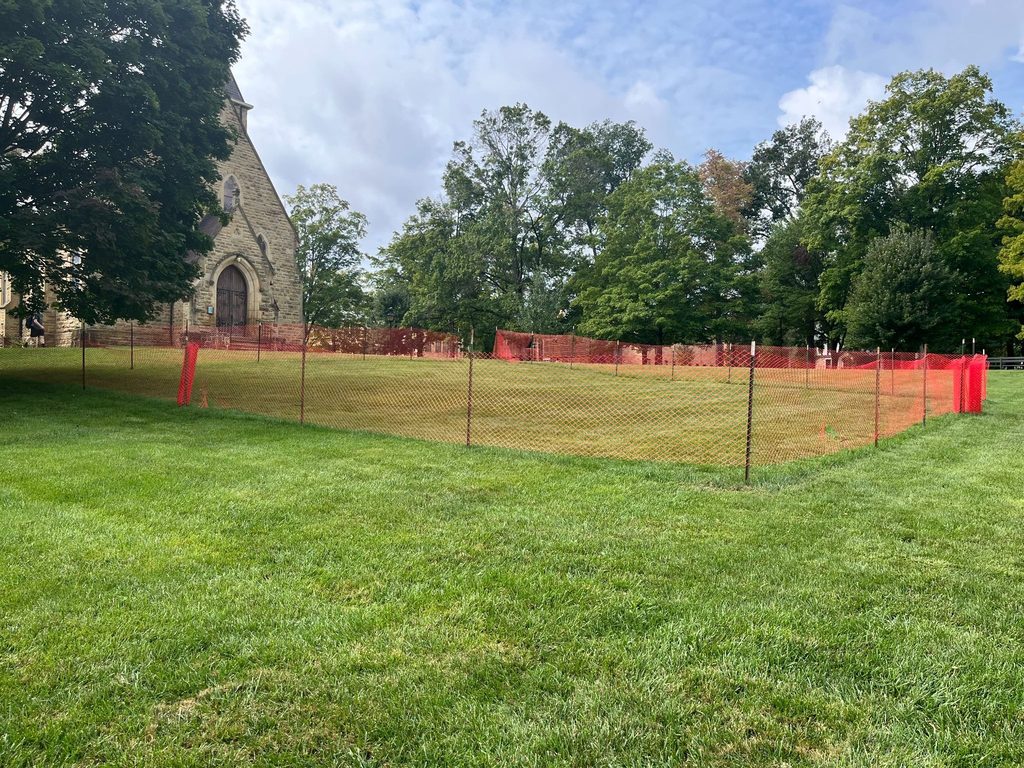
The Bishop’s Cabin Site, a few days prior to the start of the 2026 excavation, in front of the Church of the Holy Spirit.

In fall 2025, we excavated parts of the stone foundation of the original Kenyon dining hall (i.e., refectory ). The team focused on locating the corners of the structure while analyzing the larger garbage dump just outside the dining hall walls. The garbage dump revealed a host of artifacts including animal teeth and bone, ceramic sherds, and even delicate pieces of smoking pipes. These artifacts give us a snapshot of what life was like during the early days of the college, helping us to better understand students’ and faculty’s day-to-day lives in the early 19th century.

Also, during last year’s excavation, the Norway maple known as the Wedding Tree fell during a strong wind storm. Roughly dating from the founding of the college, the Wedding Tree had been a staple of Kenyon’s campus for decades, becoming a common wedding photography spot. Many members of the Kenyon community felt the loss of the old Norway maple deeply. However, the Wedding Tree’s untimely end gave the excavation a unique opportunity to “excavate” its roots. From the roots of the Wedding Tree, we recovered glass, ceramic, brick, bone, and charcoal, all dating roughly to the early 19th century. In a way, the Wedding Tree became another feature to analyze.

With what we found last year, what does this mean for the site today? In short, it means a lot more digging!

This year, we hope to uncover more of the dining hall’s stone foundation. This includes uncovering one of the foundation edges left covered last year and revealing more of the structure’s walls—something I can’t wait to see! The excavation will also focus on more areas outside of the dining hall structure. After the amazing finds from the garbage dump last year, the hope is to find more of these concentrated groups of artifacts around the dining hall. 

As for the Wedding Tree, what remains of the stump is located in Palme House. The hope is to find a way to smooth and preserve the stump to save this important piece of Kenyon’s early history. At the moment, Professor Tomás Gallareta Cervera is working with members of Kenyon’s visual arts department to find a way to save the Wedding Tree stump. 

Even with everything that has already been done, we have only scratched the surface of the Bishop’s Cabin site. It seems that it will be another wonderful year of excavation, and we can’t wait to show you what we find!   

css.php