This past week, our continued dig was accompanied by blustery weather and wet conditions – no complaints here; it kept us cool! We were quickly underway with continuing to open up new suboperations and deepen older ones, despite some mud. The day was marked by a number of small finds, all one after the other: nails with square heads, blue and white pieces of porcelain, and even what seems to be a metal handle. This variety of household remnants was found about 7 inches below the surface and deeper, among a layer of dirt that heralded the discovery of new pieces every few minutes. These hints of everyday life provided moments for reflection and insight about what objects were used by those living at Bishop’s Cabin.
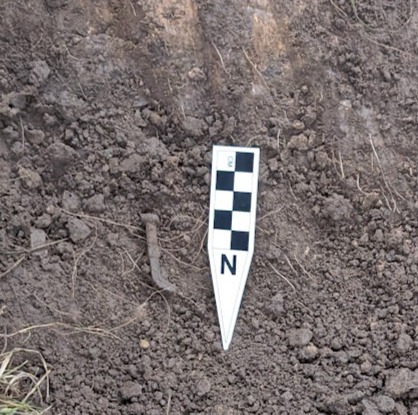
Every small find added another layer to our understanding of, and relationship to, the early days of Kenyon College. Professor Novotny noted that, in some cases, porcelain was ordered from England and sometimes personalized for the purchaser, perhaps mentioning Gambier in the images and etchings depicted on the item. It is fascinating to consider the lifecycle of a tiny shard of porcelain or ceramic found in the site, from a manufacturer overseas, to arrival in Gambier, perhaps many years of use in a kitchen or for decoration, then broken pieces forgotten in the floorboards, to be dug up years later by curious students. The same goes for the nails, especially the ones with square heads, suggesting that they were made nearby within Knox County. While not strictly “household items,” nails helped hold up the physical structure of the living space, and finding them scattered and intact is proof of a previously stable home where everyday activities took place.
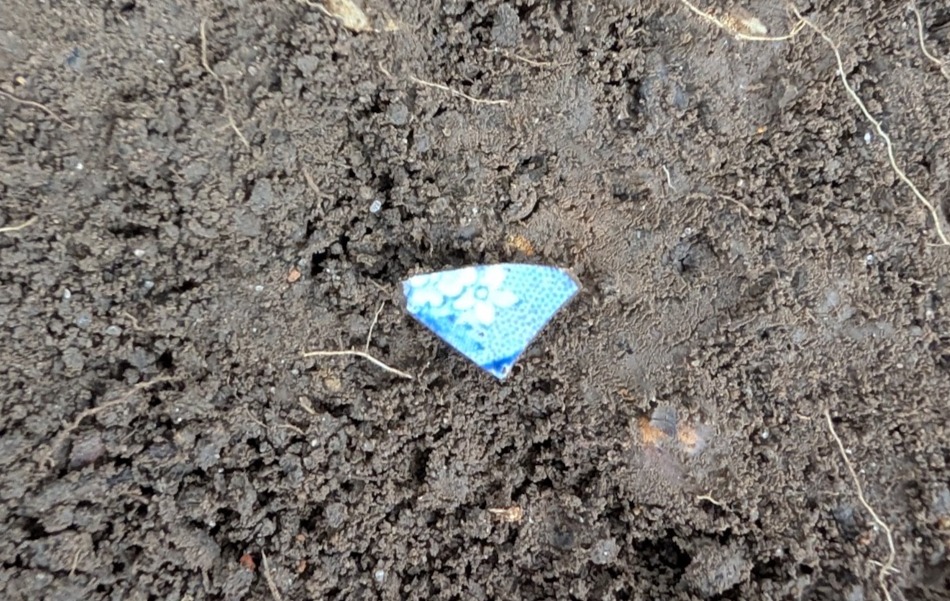
Household archaeology provides a framework for the analysis of everyday objects for the benefit of understanding the social and economic contexts of a site. Studying the household and the objects utilized within it provides a meaningful way to connect individual people to greater processes, focusing on specificity rather than a grand narrative (Pluckhan 2010, p. 332). While the foundations of the cabin and the blue rim of a plate both offer insight into daily life in 1800s Gambier, focusing on the plate shard specifically familiarizes us with the individuals whose space we are investigating, allowing us to find a relation with them. From this plate, as Professor Novotny highlighted, we can draw conclusions about broader economic processes and interactions both within and outside the household. If the porcelain is found to come from overseas, then who ordered it? What kind of utensil was the warped metal handle a part of? These and many other questions come to mind when such artifacts are uncovered, and while some may never be truly answered, the act of considering them in the first place weaves together the many processes that go into daily life in the early days of Gambier. The foundations of Bishop’s Cabin are sure to hold many more material hints of routines and practices, soon to be found in the coming weeks.
Pluckhahn, T. J. (2010). Household Archaeology in the Southeastern United States: History, Trends, and Challenges. Journal of Archaeological Research, 18(4), 331–385. http://www.jstor.org/stable/23018401

Leave a Reply